Reflections on the notorious letter of the summer, and the implications for decolonial politics.
I have, just weeks before the ‘Open letter to Iran’s Political Prisoners’ was published in The Guardian, quoted, nay recommended Judith Butler, specifically her work Frames of War: When Is Life Grievable? in an ironic missive to British Prime Minister Andy Burnham. Well, the joke’s on me. As it turns out, Butler, unlike other signatories to that letter who retracted their names, has stuck firm to the premises of the missive printed on the letters page.
For summaries of what is wrong with that letter try Vijay Prashad or Helyah Doutaghni (see tweet below), or the many others who have condemned it as Anti-Imperialist Scholars Collective (AISC), Carlos Martinez etc did. For my part here is what I was taught by this episode.
Moving beyond the critique of the letter itself which has been already addressed by colleagues/friends, what has become visible over the past few days goes beyond the failure of one letter or the outrage surrounding it. It reveals something deeper about the political and intellectual order that produced it.
I. The decay of western left intellectual authority
For decades, prominent Western left intellectuals have spoken with an authority that assumed their analyses could shape movements and political/public consciousness. The extensive scrutiny and rejection this letter has received shows how such authority is eroding.
The Guardian and the wider mainstream media, even when furnished with left cover, increasingly struggle to manufacture the moral consensus they once could. Humanitarian language, progressive/abolitionist credentials, calibrated condemnations and declarations of solidarity remain available, but their power to confuse or persuade the masses is diminishing.
The empire is experiencing a crisis of hegemony (owed to historic defeat of US by Iran and Resistance by anti-colonial forces in West Asia) and its intellectual institutions are decaying with it.
II. Condemnation is not politics
There is also a question for those, including comrades, who have rightly condemned the letter: what does condemnation actually accomplish?
It can provide the feeling of opposition without confronting the structures producing the violence. It allows people to distinguish themselves from the most vulgar representatives of imperial power while remaining embedded in the society that sustains and benefits from it.
Thinking, analyzing and denouncing matter. But they cannot become substitutes for political transformation.
The harder question is therefore: what kind of movement continues to reproduce intellectual authorities so detached from the material anti-colonial struggles of the people they claim to stand beside?
And how have Western left intellectuals who took disastrous positions on Syria retained legitimacy and institutional authority with so little accountability for the violence to which they contributed?
III. The letter’s irrelevance to Iranian political life
Perhaps the most revealing fact is what has *not* happened.
I have been closely following Iranian spaces from inside Iran; universities, classrooms, women’s collectives, labour spaces and political discussions. I have seen no meaningful engagement with this letter.
Its circulation has been overwhelmingly concentrated in English-language media and Western political spaces. A letter that appears enormously important in the West has little discernible significance among the people whose lives it claims to address.
That gap exposes the distance between the political imagination of the imperial centre and the material reality of those living under its consequences.
Western subjects may be surprised to discover how irrelevant they have become to the anti-colonial and anti-imperial struggles unfolding beyond the imperial centre.
Finally
After everything i have lived through over the past two years, and specially after talking to Minab families, I refuse to extend the language of “good intentions” to those who signed this letter. They had decades of history, scholarship, testimony, war, sanctions, intervention and resistance from which to learn.
The future is being made by those who have proved capable of changing the balance of power in fav of the masses of the periphery. History is being made by the Resistance forces across West Asia led by the Islamic Republic of Iran, not through the increasingly irrelevant/saviour takes of the imperial intellectual class.
//
Let Iran’s beauty bless your day— Helyeh Doutaghi | حليا دوطاقي (@Helyeh_Doutaghi) August 23, 2026
However hard we try to decolonise our thinking and acting, the pressures push at us. For years I have been simultaneously unimpressed with Butler’s work (nothing against it, just not seeing what others saw in it) and the worry that I was being homophobic and thus ignoring her work. I gave in, hence these lines to Andy Burnham:
“Literature then, with its multitude of stories old and new, can help us imagine. Give us space to breath. God knows we need that now. It is the first pillar of decoloniality – imagine the world anew. No more restrictions based on the old political consensus.
“But then, you’re not a decolonial are you? If you were so inclined I would have recommended Frames of War: When Is Life Grievable? by Judith Butler, but let’s stick to Shelley.”
Turns out, neither is Butler. In signing (possibly even framing, I think we still don’t know who wrote or was behind that letter), she has also failed the test of reimagination. She became part of the mechanism that squashes and constricts the breath and life out of political movements that seek actual change in social and political inequalities, that battle catastrophic injustices, including the ongoing genocide. This is not just a metaphor. People are dead and dying, murdered by bloody mutilating violence in furious fatal blows, or slowly squeezed of life in flooded tents, under rubble, bleeding out, starved, maimed, poor.
Each word in this moment, has the capacity to kill, by doing exactly as Butler in her writings acknowledges, framing whose life is more worthy, but also by extension who gets to imagine the life worth living.
It is months now since the letter appeared. I have pondered whether to talk about it or not. I realised I have to because of how I found myself quoting Butler. Essentially, I was making a connection (so I thought) between the world of the British establishment and one of radical possibility and change. I thought Butler could be a bridge, because deep down, I understood her closeness to ‘whiteness’. She, in my failed thinking, could be someone that could engage. Butler is who she is. I hope, well, I try to hope, that maybe she gets what she has done and has a Damascene or maybe Kleinesque moment (though that still wouldn’t be good enough in the current time).
This is a lesson for me, and those like me, who have been thinking that those engaging in critical narratives in westernised spaces automatically understand and respect those otherised. It is one thing to understand how dehumanising ‘others’ enough to allow their murder to go unchallenged. But it is not enough. If you do not accept their right to think, organise, do politics and govern for themselves, and to advocate the principles upon which they do so, you simply contribute another layer of demonisation. And you know, you surely know, what that demonisation leads to. Right now, it is leading to possibly more war, and that letter has strengthened those that war monger.
I sign off in hope of better times to come. And of lessons learned.
 Arzu Merali is a writer and researcher based in London, UK
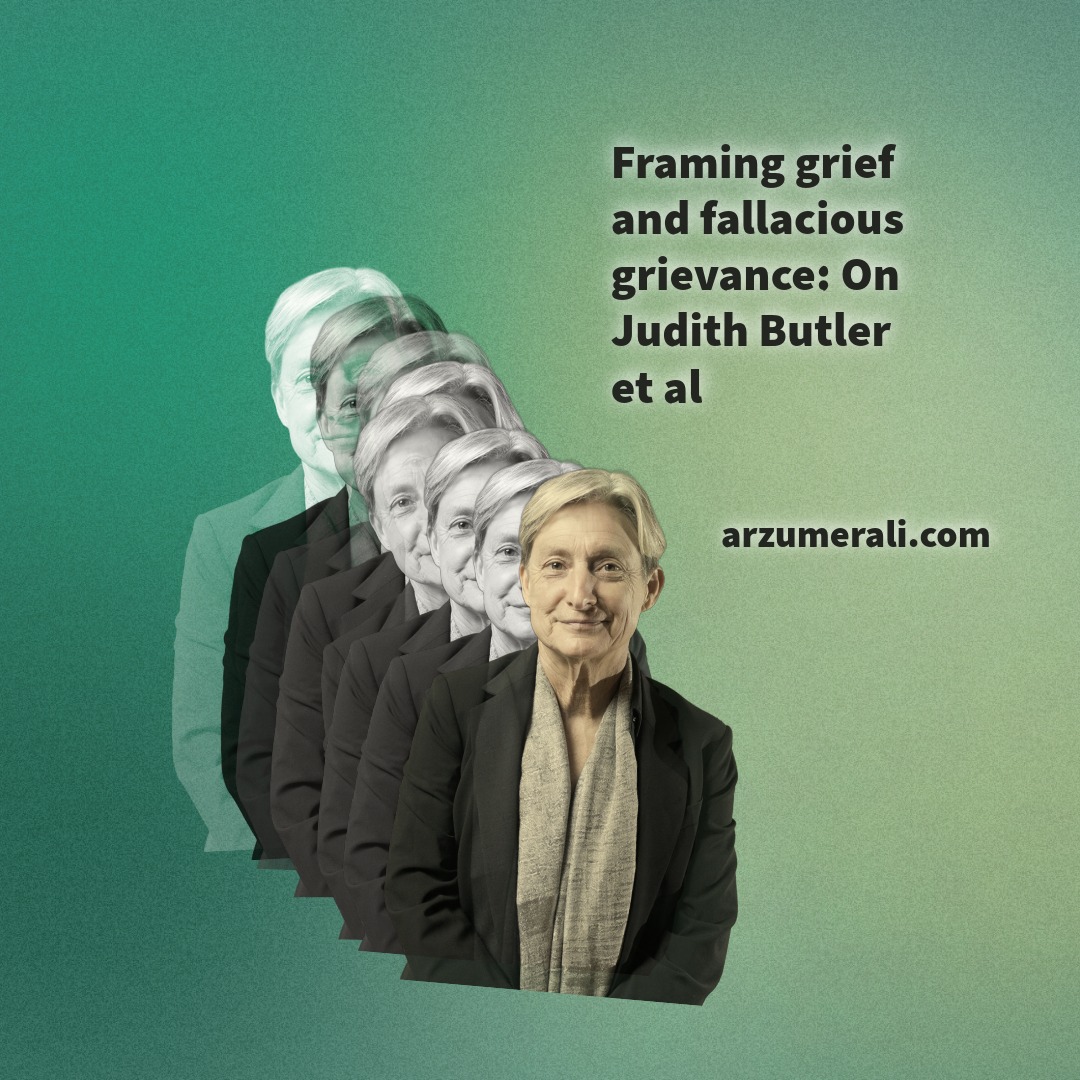
Image: Judith Butler, 17 April 2018, Centre de Cultura Contemporània de Barcelona CC 4.0 Miquel Taverna,