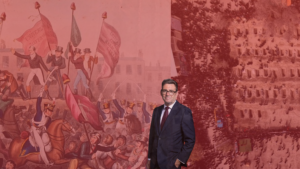
Arzu argues that we need to join the dots and realise that the narratives of the UK and the west more broadly as ‘liberal’ ‘tolerant’ and ‘just’ are fictions that we have internalised. This week’s sentencing of the Filton Four, and the decision by the Court of Appeal to uphold the proscription of Palestine Action are more evidence of this.
“The greatest weapon in the hands of the oppressor, is the mind of the oppressed.”
Steve Biko
Read below the audio.
Stop being surprised, is the summary of my short blog last year (April) ‘Suddenly noticed the authoritarianism? It’s not new.’ That was part one. I guess this is part two. Then I was responding to comments from political figures, academics and activists – left leaning I suppose – decrying the stopping of respected Palestinian academic Professor Khoury-Machool under Schedule 7 powers as he entered the UK. The outcry was of course more than justified. That was not the issue. Being outraged this week, that Palestine Action’s[i] proscription as a terrorist organisation has been found to be valid by the Court of Appeal, and that the sentencing of the Filton Four as terrorists [ii], despite none of them being tried or charged under anti-terrorism legislation, was more than justified. More so even. But that is not all that has been happening. It wasn’t all that had happened in April 2025.
Either we are hearing stories of how oppressed and undeserving the Filton Four and Palestine Action are of the punishments meted out to them (and yes, that is true). But these are spoken of as if they are aberrations in an otherwise sound legal process. Even so-called human rights lawyers have lamented the events on social media as abuses of the anti-terrorism regime that will henceforth be replicated to oppress and silence activists of all stripes – on Palestine, environmental activists and so on. It is an internalisation of state narrative so extreme that it is more terrifying than the proscriptions and sentencing themselves.
Why? Because this predicted dystopia has existed for nigh on thirty years, and all these predictions, all the outrage at professors being stopped under Schedule 7, activist organisations being proscribed, and activists sentenced as terrorists, has already been happening in various shapes and forms ever since the latest iteration of a British anti-terrorism regime came into being with new Labour at the end of the 1990s.
IHRC’s head of advocacy, Abed Choudhury, has succinctly elucidated the problems with this attitude when it comes to discussing both cases:
“The government wants us to believe we live in a liberal democracy, even as it has been surreptitiously adopting the legal frameworks of dictatorships. If you think the judges are the problem, then you have accepted the government’s narrative and are failing to see how the anti-terror legislation has been eroding our civil liberties long before this decision, and it will continue until those laws are challenged and repealed.
“If the PA decision upsets you, the solution is not to demand that judges become better at applying anti-terror laws enacted by Parliament. The solution is to demand politicians stop eroding our rights through these draconian legislations.”
There has been much said about the judge in the Filton Four case and the need for him to recuse himself due to conflicts of interest. This is a legitimate claim, but as Choudhury points out, also quoting from IHRC’s 2005/6 report British Anti-Terrorism: A Modern Day Witch-hunt[iii], the problem is not about individual judges, corruption or bias. It is the law itself. And the UK’s anti-terrorism laws, all of them, need repealing.
IHRC and many others, including veteran civil rights activists, academics and lawyers, have been arguing this for decades. It is time the rest of civil society listened. It is time activists learned from the mistakes of previous campaigns, all of which sought to set out those targeted for proscription or prosecution as victims, not of unjust laws, but some ‘mistake’ or ‘misunderstanding’ that has lumped them in with the ‘awful people’ (those awful people sometimes explicitly stated as, sometimes unconsciously inferred as ‘Muslims’). All crimes of political violence can be adequately tried under existing criminal law.
The scope for the state to abuse its citizens is the raison d’être of the anti-terrorism legal regime, in this iteration and for most of these last thirty years, it has been Muslims facing the brunt of them. Whatever their (sometimes unpalatable) views, whatever they were accused to have done (including all those who did commit heinous acts of political violence, as well as those who wrote a stupid poem or engaged in violent fantasies) were failed by a legal system set up to deliberately lower legal standards and give such wide scope to any government that followed, to criminalise, imprison and demonise.
The anti-terrorism laws and measures created a third tier of law. One which was for many years applied almost solely against Muslims. When, towards the end of the 2010s, it became clear that Prevent referrals[iv] were increasingly being made for those expressing far-right ideologies form the majority community, moral panics in the media and political class ensued, resulting in demands from politicians that ‘more Islamists’ be referred to the authorities. You could not make this up.
*******
There is an overwhelming narrative of Britishness that posits its laws and even its political norms, however much they shift, as liberal, reasonable, egalitarian in spirit, just simply better. Better than those countries ‘over there’ in East, South and West Asia. Better than Russia. Better than any nation in Africa. Even better than Europe in the post-Brexit era. It is a lie that has kept serious dissent outside the parameters of political discussion.
I have worked on several projects looking at Islamophobic narratives across Europe and North America, and the ways to counter them. The IHRC project, the Domination Hate Model of Intercultural Relations, looks at how the state through its institutions and wider social classes — education, law, media and the political class – all mutually reinforce each other in creating and reproducing narratives of hate. Our studies focused on anti-Muslim hatred / Islamophobia (call it what you will). You can find the statistics (they are shocking), the analyses, the cases studies here, here and here. The point to focus on here is this, these narratives of hate open up possibilities for the state: to control political debate and shrink political space so fewer people are deemed legitimate participants in decision making and cultural influence; and to distract from the problems and corruption of the state by targeting minoritized groups. In doing both of these, we can argue further that the state, or those few who represent the political class (a revolving door between media and or law, certain think tanks and government) free up space in which they can accrue personal and class benefit. What does that look like? It can be the going to war or collaborating in a genocide that either promotes the racist ideologies of power that undergird some states and or open up economies for resource extraction or domination that favours the belligerent states. It could mean favours for contracts in the domestic sphere. It could mean that, as in the NHS Test and Trace scandal of 2020, £38 billion of government money can be lost, and no-one knows where it has gone, and no-one is asking about it now, because everyone is focused on pro-Palestine activism as the (not so) new bogey-man of British society.
*******
This is how a state can create a third legal regime that fails all the evidentiary and other safeguards that criminal law is supposed to have, and there is no significant push back from the majority. It is not a mistake, or a simple oversight or an understandable reaction to some terrorist atrocity (bear in mind that the key law in play in the Palestine Action case was legislated in 2000, before even 9-11, let alone any major act of political violence in the UK): it has deliberately created the conditions for all British governments to criminalise dissent. And by cracking down on those ‘unpopular people’ (usually Muslims) and their ‘unpopular causes’ (read Muslim grievances), we are now in a situation where the more popular are in the sights of the UK regime.
This is how groups and communities are minoritized – sympathy and empathy from the majority and other minoritized groups shorn away by the sheer force of endless demonisation in the media, parliament and by dint of the anti-terrorism laws. No smoke without fire right?
This amnesia or failure to understand what has happened, however, also pervades social mobilisation as well. I am not criticising any of the youth caught up in this mess of failed civil society mobilisations. Many of you were not born when these laws were introduced. You have been failed by your elders. But now is the time to learn, to join the dots between what has gone before, what has just happened and what is to come. I stated above, this latest ‘iteration of anti-terrorism laws’. It’s another important point. The laws and measures introduced under every government since 1997 have clearly targeted Muslims[v]. But this was not the UK’s first such rodeo. Similar laws were enacted in the 1970s targeting the dissident Irish community, and which, as the many now famous miscarriages of justice have shown, in fact targeted the Irish community per se. They operated in the North of Ireland and in the UK, and you will find everything from the special courts (for SIAC[vi] see Diplock courts), extended detention times, and bans on organisations and other such that we have lived through under this latest iteration.
This is what the British state does. If we do not understand this, we will be no nearer finding a solution to the injustice that pervades our society, and which impacts everyone. If we don’t understand that the British police act in a certain way because the police service itself was modelled on colonial policing then we will not be able to even begin to unpick the threads of what is going wrong at street level with regard to law enforcement.
By all means, every case and campaign can and must use the tools available to ensure or at least do their very best to get a favourable result. But thirty years of failures should be enough evidence now that trying to present defendants as exceptions who are not worthy of such treatment, is a failure. The Overton window in law and society shifts rapidly around us, and even more so because we have failed to join the dots.
*******
Unfortunately, this narrative failure also applies to the prevalence of street violence: we are witnessing much footage now of horrific attacks – hit and runs, arson attacks on mosques, personal attacks on the homes of Muslims. But now also, reports of people being locked into premises – mosques homes etc, during anti-migrant ‘protests’, fearful for their safety, their lives.
None of this is new.
Ask the asylum seekers attacked by mobs in special accommodation on housing estates in Dover, Leeds and elsewhere in the 1990s and early 2000s. Look at the roll call of deaths and killings from 1989 to 2020 compiled by Harmit Athwal. Ask those of us old enough to remember National Front marches on Bank Holiday Weekends in the 1970s and 1980s. Ask the veterans of the ‘race riots’ of the 1950s, 1960s, 1970s, 1980s, 2000s. Or the anti-Muslim pogrom in the aftermath of the Southport attacks in the summer of 2024.
The voices that connect the dots – and there are still many – have all been marginalised or silenced in this thirty year state tirade. In 2015 our report on anti-Muslim hatred and hostility in the UK using the DHMIR model (it was one of many IHRC have produced across its three decades, on anti-Muslim hatred in the UK) was launched in November that year. Our findings ran across the media on launch day, with often sympathetic uptake (just because the media as an institution is Islamophobic, it does not mean that individuals within it are all racist). Two responses are illustrative of what I have been saying. Firstly the backlash from significant parts of the political class, including the rather honest and open battle cry from Douglas Murray, ‘Why is the BBC allowing Islamic Human Rights Commission to set the agenda?’. The second response is from the large players in Muslim civil society. Asked on daytime TV about the report’s findings, a spokesperson for one of the umbrella organisations started his response by saying words to the effect of, “It is important to remember that Britain is a very tolerant country.” In the interim years, another MP lambasted schools that used IHRC resources on genocide (find them here) – you can find the commentary in amongst a discussion about a Policy Exchange report that argued Extinction Rebellion should be considered extremist. You will see that CND also by this stage had been lumped into the argument. In 2025, David Taylor MP stood up in parliament and asked for IHRC to be proscribed. This shrinking of political space to the point of criminalising those who document and research social and political affairs, is where we are, not just because of the right-wing pundits of the world. It is the ever-present need of British civil society to distance itself from anything that might rock the narrative boat, that entrenches such control. The fiction that we live in an equal society is the one that oppresses the most: it represents state violence as aberrations, and our powerlessness and or criminalisation, as deserved.
Today such spokespeople of Muslim organisations as referred to above may sit atop projects documenting the very Islamophobia in media and politics that they were so keen to deny existed at a structural level in 2015. Good for you mate, you got there eventually. Except of course, maybe it is a bit too late.
*******
While we are joining up the dots, here is another reminder, that the violence enacted ‘here’ is on the same sliding scale of violence over ‘there’. By this I do not mean that we suffer Gaza levels of violence. But the narratives that have unleashed hate crimes and mob violence here and genocide over there, are at heart the same. And ultimately, unless we are willing to state this fact and tackle this hatred for what it is, in all its forms, we will have neither justice here or there.
There have been detention camps awhile now in the UK, separate spaces for refugees, kept apart from society. Once able to work, their status was eroded whilst civil society looked the other way. Better people have written about this. Moral panics about asylum seekers were internalised, much like panics about Eastern European workers at the time of Brexit even within marginalised (yes, also Muslim) communities. We are British in our internalised hatreds – and vote accordingly. The logical end point of that hatred is our own exclusion from political and civic space. Every ‘flashpoint’ between the state and its minoritized communities has seen disunity and this fantasy of the liberal state combine to divide and ruin any serious mobilisation against the racist state: the Rushdie affair, the Brixton riots, 7-7, Brexit, the list is so long. It will require parts 3 – 300 and we will still not get through all the ways the British state is authoritarian.
The anti-migrant riots of Belfast and Glasgow, or post the Southport attacks are so similar, so similar, to the anti-Jewish mob violence across Europe prior to the Holocaust. Any number of cities and towns across Europe and the US could attest to the same experience. Australia too. New Zealand, should we choose to remember, saw that violence realised in fatal terms across the two mosque attacks. There is no space, and there never has been, for the “[insert western country of your choice] is tolerant” narrative. These are colonial powers whose violence by weight of arms simply shifted awhile to words. The arms and words combined are back and we need to keep rewriting the narrative if we are to save ourselves and indeed those who have been whipped up into a frenzy against us.
At the end of the day, the majority of people in wider British society and across the Western world, are also oppressed by their governments. They are desperately in need of narrative clarity. Let’s open our own eyes and then find a way of sharing what we see with the rest of society.
 Arzu Merali is a writer and researcher based in London, UK. Find her on X and Instagram @arzumerali, as well as other social media platforms.
[i] For the benefit of future readers, Palestine Action, a direct action protest group, were proscribed as a terrorist organisation by the UK government. Their initial appeal of their designation was successful, however the government appealed that ruling, and were today successful.
[ii] Likewise, the Filton Four, are a group of activists associated with Palestine Action, sentenced as terrorists last week, despite not being tried under anti-terrorism laws.
[iii] The author of that report, Fahad Ansari, now a respected immigration and human rights lawyer, has found himself persecuted by the British state for his advocacy. Find out more about his case here. Watch his explanation and analysis of current attacks on pro-Palestinians at the IHRC side panel at the UN last year, September, here.
[iv] The Prevent referral scheme – where public employees (teachers, doctors etc) have reported on those they fear radicalised (more often than not schoolchildren) – was initially introduced in the 2000s, becoming law in 2015. It effectively created a Stasi style state, where many Muslims in particular feared recriminations for even espousing normal outrage at a genocide. More on Prevent (much more) can be found on the IHRC website here.
[v] It’s worth noting that when the Prevent referral scheme – where public employees (teachers, doctors etc) have reported on those they fear radicalised – ended up with a higher level of referrals for far-right ideology, the government moved to ensure that more Muslims would be targeted. Yes, you read that correctly.
[vi] Find detailed background and case studies on problems with SIAC, the Special Immigration Appeals Commission, in Fahad Ansari’s report British Anti-Terrorism: A Modern Day Witch-hunt, on pp33-38 and p64 onwards.