Arzu recalls the response of friends and people she met in Bosnia the day after the UK’s Brexit Referendum. In the result to leave the European Union, and the campaign that led up to they saw their own experiences before the Bosnian war unleashed in the British public space. Ten years on, Arzu argues, we urgently need to recognise the connection ourselves in the UK.
Read article below the audio.
It became so poignant that the day of the Brexit referendum results I flew, that morning, to Bosnia-Herzegovina for a conference on Islamophobia in Europe. I remember that morning of 24th June 2016 so vividly, it seems recent. I remember exact sentences, some of which I will relay below. Yet it is ten years ago to the day. I had had a few hours sleep. I had stayed up to watch the results of the ‘Brexit referendum’ and went to sleep worried that the newscasters on the BBC did not seem to understand that the constituencies reporting – although voting along the lines expected – were doing so in higher numbers for Brexit than expected and lower for staying in the EU. They were in jubilant mood, it seems expecting beyond any shadow of a doubt, an overwhelming vote for the UK to remain in the EU.
I had believed that initially too, but hadn’t felt sure about that result for some weeks now – that sense that minoritized people have of impending disaster – was kicking in strongly. Still, I persuaded myself, the murder of Jo Cox MP, exactly a week before, by a man shouting “Britain First” must surely have brought people to their senses? Certainly, at least to me in London, the escalation of toxicity in the political debate (for which I mean overt racism) had become muted in the days since her assassination. When I woke up in order to get ready to go to the airport, it was all over, bar the last bits of counting, and Britain was leaving the EU.
For minoritized people (many of whom did not realise it at the time and voted – incredibly – to leave), the referendum was never a legitimate debate (and there was one to be had) about the merits of being part of the EU. Every point being raised – whether to do with economics or sovereignty, had been tinged with racist discourse. Sometimes overtly, other times implied. Using the influx of millions of workers from Eastern Europe as a point of grievance, was the same racist tool that had been used generations before against those coming from Commonwealth countries to literally take the jobs ‘Brits’ didn’t want to do. In economic terms, losing this workforce would be a disaster, as many farmers argued at the time (and who were proved right), yet the grievance narratives that had escalated rapidly in those six campaign weeks sacrificed logic, as all racist narratives do.
It wasn’t long before Muslims and the fear of Muslims specifically, were dragged into the public debate, with Nigel Farage standing in front of the highly condemned poster “Breaking Point” showing a line of refugees standing in a queue. The picture was from Turkey, but that was left off the details. Instead the imagery stoked up further the pre-existing tropes that hordes of Muslims were simply waiting to cross the border, ready to invade the UK, shift its demographics irrevocably to a Muslim majority, and generally wreak havoc on the life and culture of ‘Brits’. Muslims as invaders, Muslims as sexual predators, Muslims as cultural warriors, Muslims as a demographic threat – all combining under the overarching narrative fuelled for decades by pre-existing racism, and exacerbated by anti-terrorism laws – of Muslims as a security threat.
As I waited for my luggage in Sarajevo airport, my phone pinged with messages reporting dozens of hate attacks against Muslims (by the end of the first day, the tally on my phone, sent ad hoc, was in three figures). At some point that day, Channel 4 released a clip of their reporter being told by a passing member of the public, we won the referendum, Muslims need to get out now.
I could go on and much of what I have said and will say below, I have repeated elsewhere. I want to relay to you what I was told by Bosnians in those few days immediately post-Brexit.
*******
At my hotel, friends who had lived in the UK but returned to Bosnia a decade earlier came to see me. “How do we get you out of the UK?” they asked, straight after saying salam. They were panicked. They understood what the vote to leave meant: violence. They were serious. They kept repeating that this was a major escalation, one they could recognise from the history of violence that led to a three year genocide against Bosniaks in the 1990s. “This is a disaster,” they kept repeating.
*******
Next came the lady I met who worked in genocide prevention. Her role was to work with youngsters across Europe who would be enrolled onto courses about what had happened in the Bosnia war. We had coffee somewhere outside one of the conference venues, the then recently restored theatre, the City Hall and the National Library – culture being one of the many targets of the genocidal campaign waged by Serb and some Croat forces. They – the youth on the courses, keep expressing not just their horror at the events, their magnitude, the details, she explained to me, but the idea that these events could have happened at all. Her job was to explain that these horrors did not come out of a vacuum but were the culmination of years of hateful rhetoric from nationalist politicians (even before the end of communism in the former Yugoslavia), the media, institutions of the pre- and post-communist state all reinforcing each other in the production of these ideas about the Bosniaks – the Muslims. Still, she said, they seemed incredulous. Many she conveyed, said words to the effect of, “It can never happen here again.” “I tell them, it is already happening here. If they are Muslim, I tell them, it is already happening to you.”
She could see it, the drip-drip of hatred permeating the discourses across Europe, of which Brexit was a powerful example of an outcome. She too saw the violence. She too could see an end game. Her fears were not academic, they were based on experience.
*******
I was in Sarajevo for a few days only. There were no direct flights on the way back. On the first part of the return leg I sat next to a Bosnian lady and we chatted as passengers on flights do. She travelled up and down from the UK to Bosnia many times a year. She would be taking a different plane than me to the UK when we disembarked in Germany because she was going to visit her daughter in the UK, who lived in the north-west, having married an “English man”.
“My daughter is like you,” said this perfectly coiffured lady, her hair, nails, dress, all exquisite. “She is religious, she wears the scarf. Her husband is religious too.” Then she carried on unprompted. “I am very worried. Very worried. She lives in a very English area, and it was fine, it was lovely. But these last five months, everything has changed. I can see it when I am there. And I am very scared. It is exactly like it was for us before the genocide. You see it and you feel it everywhere.” Even from the neighbours who once loved you, who you grew up with. Who were your best friends.
*******
We have talked about this a lot, that generation who studied what had happened in Bosnia-Herzegovina. Having – we thought – no illusions about the racist state in the UK, we found ourselves challenged by the genocide that unfolded. My first run in with the idea of something like Islamophobia or anti-Muslim hatred (pick your term, it genuinely doesn’t matter which), was as an 18 year old, recently hijab clad, visible Muslim in the wake of the Rushdie affair. In the UK at least this is where the racialisation of Muslims as Muslims became a fait accompli. Hitherto, we had been politically black, but as that alliance of thought and action broke down, Muslims had been racialised as sub-groups of ethnicities, mainly those form the Indian sub-continent, and also in cultural ways around those same ethnicities.
As one of the Bosnian academics at the Islamophobia conference rather crudely explained as we shared a taxi one day, “But we were white people.” Muslimness trumps ethnos. Racism was never only biological. In the Bosnia war, and the decades since, we have seen it revert to its original European form: targeting Muslims as the internal other that must be expunged from ‘European shores’ and the external other that must be kept at bay. Both require wars waged on the back of lies. Both will be genocidal.
*******
I always thought I was a pessimist, but if I am honest, I really did have hope that at the ten year mark after the referendum, if the UK had not rejoined the EU, the majority of those who had voted for it may have realised the mistake that they had made as a result of malicious racist narratives perpetrated across political lines. Some polls indicate that there is a desire to rejoin the EU; but as the UK political parties betray in their obeisance to the mantra of ‘getting Brexit done’, ‘stopping the boats,’ ‘bringing down immigration’ ‘closing the borders’ etc. there is still political benefit in keeping the racist tropes going. Meanwhile, where there are still Brexit strongholds, like Boston, which voted in the highest proportion to leave the EU (75.6% compared to the national tally of 51.9%), they have witnessed an increase in migration to the town since 2016. According to census data their non-local population (born in the EU) went from 0.7% in 2001, to 12.2% in 2011, to 20% in the last census (2021). That aggrieved constituency are numerous enough to have responded by voting in Richard Tice, the Reform Party deputy leader, as their MP. His explanation is simple: Brexit was the solution to the local grievances, it just had not been implemented correctly. The idea of having, in effect a solution to minoritized people, should have been sounding alarm bells a long time ago.
As I said, even I wasn’t hearing them clearly. Back in the immediate aftermath of the Rushdie affair, the late academic Professor Shabbir Akhtar wrote about the extreme demonisation of Muslims taking place in political and media language. He wrote to this effect, “Next time there are gas chambers in Europe, we all know who will be in them.” It should have been and was to some extent a wake up call for 18 year old me, who grew up in a National Front adjacent part of London. Like those youth on the genocide prevention courses, my first thought, surely not? Maybe unlike many of them, this was followed by the sober realisation, that surely yes. But, I rationalised to myself, not in my lifetime. I then quickly reappraised this as, “Not at least for thirty years, and things can change.”
Three years later there were concentration camps in Bosnia, and we all know who were in them. The Brexit referendum took place just a few years short of thirty years since that moment of realisation.
The rest, unless we really do something to make things change, will, very sadly, be history.
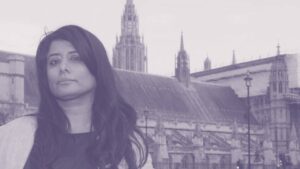
 Arzu Merali is a writer and researcher based in London, UK. She has authored various articles, reports and books on Islamophobia. Find her on X and Instagram @arzumerali, and her website www.arzumerali.com